

What Does NGL Mean in Text Meaning, Examples
wordfigures.com >> Uncategorized>> What Does NGL Mean in Text Meaning, Examples
What Does NGL Mean in Text Meaning, Examples
If you’ve ever received a message like “NGL, that was actually pretty good” or “NGL 😂 I didn’t expect that,” you may have wondered what the abbreviation means. So, what does NGL mean in text?
NGL is a common piece of internet slang used in texting, online chats, and social media. It is short, casual, and usually adds a little honesty or emphasis to what someone is saying.
Quick Answer: What Does NGL Mean?
NGL means “Not Gonna Lie.” People use it in texts and social media to introduce an honest opinion, confession, reaction, or personal feeling. For example, “NGL, I really enjoyed that movie” means “Not gonna lie, I really enjoyed that movie.” It is informal and commonly used in casual conversations.
In most situations, NGL stands for “Not Gonna Lie.” It can be placed at the beginning of a sentence, in the middle of a message, or occasionally on its own as a reaction.
What Does NGL Mean in Text?

When someone writes NGL in a text, they are usually signaling that they are about to say something honestly.
For example:
NGL, I’m really tired today.
This simply means:
Not gonna lie, I’m really tired today.
The phrase doesn’t necessarily mean the person has been lying before. Instead, it works more like a conversational signal: “I’m going to be honest about how I feel.”
You might see NGL before an opinion, compliment, criticism, admission, joke, or unexpected reaction.
Common examples
- NGL, that food was amazing.
- NGL, I was nervous before the exam.
- That game was hard, NGL.
- NGL 😂 I wasn’t expecting that.
- NGL, you did a great job.
The meaning stays essentially the same, even though the position of the abbreviation changes.
What Does NGL Stand For?
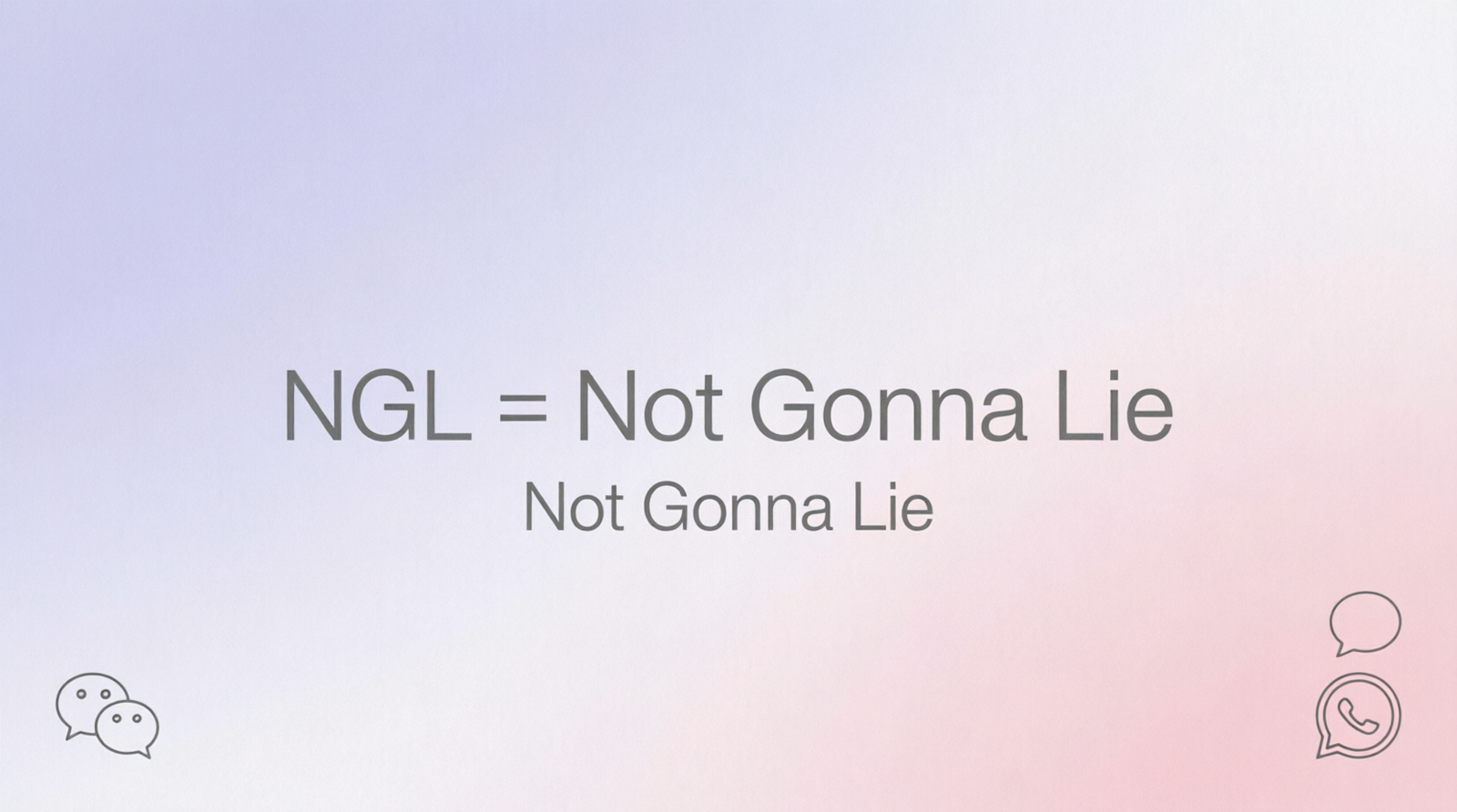
NGL stands for “Not Gonna Lie.”
Here, “gonna” is the casual spoken form of “going to.” The abbreviation takes the first letters of:
- N = Not
- G = Gonna
- L = Lie
So:
N + G + L = NGL
You may also see people write the full phrase as “not gonna lie” rather than using the abbreviation. Both have the same basic meaning.
For example:
“NGL, this is my favorite song.”
and
“Not gonna lie, this is my favorite song.”
communicate the same idea. The first version is simply quicker and more typical of online conversation.
The Most Common Meaning of NGL
The overwhelming everyday use of NGL in texting is “Not Gonna Lie.”
People use it to make a statement sound more candid or personal. It can introduce something they genuinely think or feel.
NGL can introduce an opinion
NGL, I think the old version was better.
The speaker is giving their honest opinion.
NGL can introduce a compliment
NGL, your new haircut looks great.
The abbreviation makes the compliment feel casual and sincere.
NGL can introduce an admission
NGL, I forgot about the meeting.
The speaker is openly admitting something.
NGL can introduce a reaction
NGL 😭 that was hilarious.
The person is emphasizing their genuine reaction.
This flexibility is one reason NGL became so common in casual digital communication.
What Does NGL Mean in Texting?
In texting, NGL usually means “Not Gonna Lie” and is used to emphasize honesty.
Imagine a friend asks:
“Did you like the restaurant?”
You could answer:
“NGL, the food was better than I expected.”
You’re basically saying:
“Honestly, the food was better than I expected.”
NGL can also soften a criticism:
“NGL, I wasn’t a huge fan of the ending.”
Instead of sounding like a blunt criticism, the message feels more conversational and personal.
It can even be used before something positive:
“NGL, you absolutely nailed that presentation.”
In this case, the speaker isn’t confessing anything negative. They’re simply emphasizing that the compliment is genuine.
What Does NGL Mean on Social Media?
On platforms such as Instagram, TikTok, Snapchat, X, Facebook, and other social networks, NGL still generally means “Not Gonna Lie.”
Its meaning doesn’t change just because it appears on social media instead of in a private text.
You might see it in:
- Comments
- Captions
- Direct messages
- Replies
- Memes
- Videos
- Group chats
- Posts and status updates
For example, someone might post:
NGL, this might be the best pizza I’ve ever had.
Or comment:
NGL, I need this outfit.
The abbreviation makes the statement feel informal and conversational.
Why people use NGL online
Social media conversations often favor short expressions. Writing NGL is faster than writing “not gonna lie,” and many users already understand what it means.
It also gives a message a particular tone. Compare:
“I really like this.”
with:
“NGL, I really like this.”
The second version sounds more like someone casually sharing an honest thought with a friend.
How to Use NGL in a Text
Using NGL is easy. In most casual conversations, you can put it at the beginning of a statement.
1. Put NGL at the beginning
This is probably the most common structure.
I’m impressed.
I thought you were going to lose.
that was really funny.
The abbreviation introduces what follows.
2. Put NGL at the end
NGL can also appear at the end of a sentence.
That movie was pretty good, NGL.
I actually enjoyed the class, NGL.
This structure is especially common in casual online writing.
3. Use NGL before a personal opinion
NGL, I prefer coffee over tea.
Here, the abbreviation signals that the person is sharing their genuine preference.
4. Use NGL before an admission
NGL, I haven’t started my homework yet.
It can make a confession feel lighter and more conversational.
5. Use NGL with emojis
People often combine NGL with emojis to make the intended emotion clearer.
hat was so funny.
I can’t stop laughing.
this is adorable.
The emoji isn’t part of the abbreviation’s meaning, but it helps communicate the tone.
NGL Text Examples and Conversations
Seeing NGL in different situations makes its meaning much easier to understand. Here are several realistic examples.
Example 1: Talking about food
Person A: Did you like the new burger place?
Person B: NGL, the fries were amazing.
Meaning: Person B is honestly saying that they really liked the fries.
Example 2: Giving an opinion
Person A: Which phone do you think looks better?
Person B: NGL, I like the black one more.
Meaning: Person B is casually giving their honest preference.
Example 3: Admitting something
Person A: Did you finish the assignment?
Person B: NGL, I completely forgot about it.
Meaning: Person B is honestly admitting that they forgot.
Example 4: Complimenting someone
Person A: I wasn’t sure about my presentation.
Person B: NGL, you did really well.
Meaning: Person B is emphasizing that the compliment is sincere.
Example 5: Reacting to something funny
Person A: Did you see that video?
Person B: NGL 😂 I watched it three times.
Meaning: Person B genuinely found the video funny or entertaining.
Example 6: Talking about a movie
Person A: Did you enjoy the movie?
Person B: NGL, the first half was slow, but the ending was great.
Meaning: Person B is giving an honest, balanced opinion.
Example 7: Talking about school
Person A: How was the exam?
Person B: NGL, it was harder than I expected.
Meaning: The speaker is honestly saying the exam was difficult.
Example 8: Talking about someone’s appearance
Person A: Do you like my new jacket?
Person B: NGL, it looks really good on you.
Meaning: The speaker is giving a genuine compliment.
Example 9: Using NGL at the end
Person A: Would you watch that series again?
Person B: Yeah, I actually would, NGL.
Meaning: The person is casually emphasizing that they really would watch it again.
Example 10: NGL as part of a longer thought
Person A: Are you nervous about moving to a new city?
Person B: NGL, yeah. I’m excited too, but it’s definitely scary.
Meaning: The speaker is openly admitting that they feel nervous.
Can NGL Be Used by Itself?
Yes, although the exact meaning depends on the conversation.
Someone might respond:
“NGL 😭”
or
“NGL 😂”
after something surprising or funny.
In these cases, NGL can function almost like “Honestly…” or “I have to admit…”
For example:
Person A: I ate the entire cake.
Person B: NGL 😂
Here, Person B could be implying something like:
“Honestly, I can’t even judge you.”
The exact message comes from the surrounding conversation, so NGL by itself can be less precise than using it in a complete sentence.
How to Respond When Someone Uses NGL
You don’t need a special response just because someone uses NGL. Treat it like an ordinary statement.
If someone says:
“NGL, I really like your new shoes.”
You can simply say:
“Thanks!”
If someone says:
“NGL, that movie wasn’t very good.”
You could respond:
“Yeah, I kind of agree.”
Or, if you disagree:
“Really? I actually loved it.”
The abbreviation doesn’t require a particular reply. The best response depends on what the person says after NGL.
If they give you a compliment
You can say:
- “Thanks!”
- “I appreciate that!”
- “Haha, thank you!”
If they share an opinion
You can agree:
- “Same!”
- “I think so too.”
- “Exactly!”
Or disagree politely:
- “I see what you mean, but I liked it.”
- “Really? I had the opposite opinion.”
If they make an admission
You can respond naturally:
- “Haha, it’s okay.”
- “I figured 😂”
- “Don’t worry, it happens.”
Is NGL Formal or Informal?
NGL is informal slang.
It is appropriate for casual communication with friends, classmates, family members, and people you regularly chat with online.
You generally shouldn’t use NGL in formal writing such as:
- Business reports
- Academic essays
- Job applications
- Professional emails
- Official letters
- Formal presentations
For formal communication, write the meaning directly.
Instead of:
“NGL, I think this proposal needs some changes.”
a professional version would be:
“Honestly, I think this proposal needs some changes.”
Or:
“In my opinion, this proposal needs some changes.”
NGL belongs naturally in relaxed digital conversations, not formal documents.
Does NGL Always Mean “Not Gonna Lie”?
In modern texting and social media, “Not Gonna Lie” is by far the most likely interpretation when NGL appears as a casual slang abbreviation.
However, abbreviations can have multiple meanings in specialized contexts. A company, organization, technical document, game, or professional field could potentially use NGL for something completely different.
That’s why context matters.
If your friend sends:
“NGL, that was awesome.”
there is little doubt that they mean “Not Gonna Lie.”
But if you see NGL in a technical document, report, or specialized conversation, don’t automatically assume it has the texting meaning. Look at the surrounding words.
For everyday texting, though, Not Gonna Lie is the meaning you should expect.
NGL vs. TBH: What’s the Difference?
A very similar abbreviation is TBH, which means “To Be Honest.”
Both NGL and TBH can introduce an honest opinion.
NGL
“NGL, I really enjoyed the concert.”
TBH
“TBH, I really enjoyed the concert.”
The two sentences are very similar.
There is a slight difference in conversational feel. NGL often sounds like a casual admission or reaction, while TBH can feel more directly like an honesty marker.
But in everyday texting, people often use them in nearly interchangeable ways.
NGL vs. IMO
Another abbreviation you may encounter is IMO, meaning “In My Opinion.”
For example:
“IMO, the second movie was better.”
This specifically identifies the statement as an opinion.
NGL is broader:
“NGL, the second movie was better.”
This emphasizes honesty rather than simply identifying something as an opinion.
So:
- NGL = Not Gonna Lie
- TBH = To Be Honest
- IMO = In My Opinion
- IMHO = In My Humble Opinion
They overlap, but they aren’t exactly the same.
Similar Slang Words and Abbreviations
If you’re learning internet slang, you’ll probably encounter NGL alongside many other short expressions.
TBH — To Be Honest
Used when someone wants to express an honest opinion.
“TBH, I don’t really like it.”
IMO — In My Opinion
Used to introduce a personal opinion.
“IMO, this is the better option.”
IMHO — In My Humble Opinion
A longer, slightly playful way of saying “in my opinion.”
“IMHO, the original is better.”
FR — For Real
Used to agree strongly or emphasize that something is true.
“That was difficult, FR.”
IDK — I Don’t Know
Used when someone isn’t sure about something.
“IDK what time they arrive.”
LOL — Laughing Out Loud
Used to show amusement or indicate that something is funny.
“LOL, I can’t believe you did that.”
BTW — By the Way
Used to introduce an additional point.
“BTW, don’t forget your keys.”
These abbreviations all have slightly different jobs, but they’re common in the same informal online environment as NGL.
When Should You Avoid Using NGL?
Although NGL is perfectly normal in casual messaging, it isn’t suitable everywhere.
Avoid it when you’re writing something that needs a professional or formal tone.
For example, don’t write:
“NGL, I think the customer needs more information.”
in a formal business report.
Instead, write:
“I believe the customer needs more information.”
Likewise, an academic assignment should use standard language rather than texting abbreviations.
The simple rule is:
Use NGL when you would naturally say “not gonna lie” in a casual conversation.
If the situation calls for polished formal English, spell out the idea or use a more professional phrase.
Why Is NGL So Popular?
Part of the appeal of NGL is that it is short but expressive.
Texting has encouraged people to communicate quickly, and abbreviations make common phrases easier to type. But NGL isn’t only about saving a few keystrokes.
It also adds personality.
Compare these messages:
“That was unexpected.”
and:
“NGL, that was unexpected 😂.”
The second feels more like a casual conversation between people who know each other.
NGL can signal that the speaker is being candid, playful, surprised, impressed, disappointed, or amused. The words that follow—and sometimes the emoji—determine the exact emotional tone.
Is NGL Rude?
No, NGL is not inherently rude.
It depends entirely on what comes after it.
For example:
“NGL, you look amazing.”
is clearly positive.
But:
“NGL, your idea makes no sense.”
could sound blunt or critical.
The abbreviation itself doesn’t make a statement rude. It simply introduces the statement as something the speaker wants to present honestly.
Tone also matters. A message with a laughing emoji might sound playful, while the same words without context could sound more serious.
Is NGL the Same as Being Honest?
Not exactly, but it is closely connected to the idea of honesty.
When someone writes “NGL,” they’re telling you that what follows is their genuine thought, feeling, or reaction.
However, it doesn’t automatically guarantee that everything they say is objectively true. It is simply a conversational way of saying:
“I’m being honest about my perspective.”
For example:
“NGL, I think this is the best restaurant in town.”
That’s an honest opinion, but someone else can reasonably disagree.
How to Remember the Meaning of NGL
If you have trouble remembering internet abbreviations, connect the letters to the full phrase:
N = Not
G = Gonna
L = Lie
So:
NGL = Not Gonna Lie
A simple memory trick is to think of NGL as another way of saying “Honestly…”
Whenever you see:
“NGL, this is great.”
you can mentally translate it to:
“Honestly, this is great.”
That makes the abbreviation much easier to understand in conversations.
FAQs:
What does NGL mean in text?
NGL means “Not Gonna Lie.” It is used in texting to introduce an honest opinion, feeling, admission, or reaction. For example, “NGL, I’m tired” means “Not gonna lie, I’m tired.”
What does NGL stand for?
NGL stands for “Not Gonna Lie.” The letters come from the first letter of each word: Not, Gonna, Lie.
Is NGL slang?
Yes. NGL is considered informal internet and texting slang. It is common in casual messages, chats, comments, and social media posts.
What does NGL mean on TikTok, Instagram, or Snapchat?
On social media platforms such as TikTok, Instagram, and Snapchat, NGL generally means “Not Gonna Lie.” Its meaning is essentially the same as it is in text messages.
How do you use NGL in a sentence?
You can usually put NGL at the beginning or end of a casual sentence. For example: “NGL, that was the best part.” You can also write, “That was pretty funny, NGL.”
How should I respond when someone says NGL?
There is no special response required. Simply respond to the statement that follows NGL. If someone gives you a compliment, you can say “Thanks!” If they share an opinion, you can agree or give your own view.
Is NGL formal or informal?
NGL is informal. It is suitable for casual texting and social media but generally isn’t appropriate for academic papers, professional reports, job applications, or formal business communication.
Does NGL always mean “Not Gonna Lie”?
In casual texting and social media, NGL almost always means “Not Gonna Lie.” However, abbreviations can have different meanings in specialized industries or contexts, so the surrounding conversation should always be considered.
Final Takeaway:
So, what does NGL mean in text? In everyday texting and social media, NGL means “Not Gonna Lie.”
People use it when they want to introduce an honest thought, opinion, confession, compliment, or reaction. It can appear at the beginning of a sentence NGL, I loved it or at the end I loved it, NGL.”
The easiest way to understand it is to replace NGL with “honestly” or “not gonna lie.”
Remember that NGL is casual slang. It’s great for conversations with friends and online communities, but formal writing calls for standard language.
Once you know this abbreviation, messages such as “NGL, that was hilarious 😂” become pretty straightforward: the person is simply saying that they’re being honest about how they felt.
In short:
NGL = Not Gonna Lie = Honestly / I’m being honest.
Discover more post:
| https://wordfigures.com/what-does-ada-mean-in-text/ |
| https://wordfigures.com/what-does-nth-mean-in-a-text/ |
| https://wordfigures.com/what-do-oop-mean-in-text/ |

Rosalie is a passionate writer, language enthusiast, and literary content creator with over 5 years of experience exploring the beauty of words, language, literary devices, figurative expressions, and their meanings. Through her work, she turns confusing words and complex language concepts into clear, simple, and easy-to-understand explanations for everyday readers.
Related Post

What Does aloc Mean in Text? Real Meaning 2026
If someone sent you a message containing “aloc , you may have paused and wondered…
3 thoughts on “What Does NGL Mean in Text Meaning, Examples”