
What Does IDK Mean in Text? Meaning
wordfigures.com >> Uncategorized>> What Does IDK Mean in Text? Meaning
What Does IDK Mean in Text? Meaning
If you’ve ever received a message that simply says “IDK”, you may have wondered what it means or how you’re supposed to respond.
The good news is that IDK is one of the most common texting abbreviations in everyday online communication.
In this guide, we’ll explain what does IDK mean in text, where it comes from, how people use it, and what it can mean depending on the conversation.
Quick Answer: What Does IDK Mean in Text?
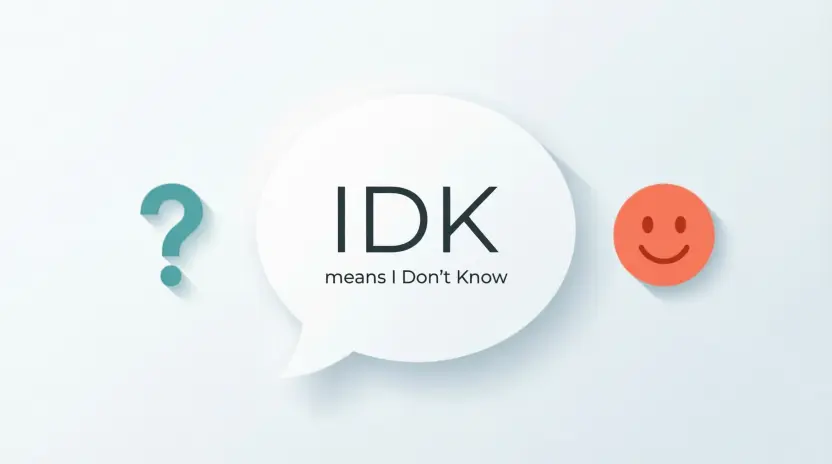
IDK means “I don’t know.” It is a common informal abbreviation used in texting, messaging, social media, and online conversations when someone does not know the answer to something or is unsure about a situation. For example, “IDK what time the movie starts” simply means “I don’t know what time the movie starts.”
What Does IDK Mean?
IDK stands for “I don’t know.”
It is formed from the first letters of the three words:
- I = I
- D = Don’t
- K = Know
People use IDK to communicate uncertainty, lack of knowledge, or sometimes simple indifference. It is especially common in text messages because abbreviations make casual conversations faster and easier.
For example:
Person A: What time is Sarah coming?
Person B: IDK, she hasn’t told me yet.
Here, IDK has exactly the same meaning as “I don’t know.”
The abbreviation is short, familiar, and easy to understand, which is why it has remained popular even as texting and social media have changed over the years.
The Most Common Meaning of IDK
The most common IDK meaning in text is simply “I don’t know.”
Someone might use it when:
- They genuinely don’t know an answer.
- They haven’t received the information yet.
- They are uncertain about something.
- They don’t want to give a definite answer.
- They are unsure what to do.
- They don’t particularly care about the question.
Consider these examples:
“IDK where my keys are.”
This means:
“I don’t know where my keys are.”
Or:
“IDK if I’ll be able to come tomorrow.”
This means:
“I don’t know if I’ll be able to come tomorrow.”
The meaning is usually straightforward, but the tone can change depending on the conversation.
For example, “IDK 😂” between close friends may sound playful, while “idk” in response to a serious question could sound uncertain, uninterested, or even slightly dismissive.
That’s why understanding the surrounding conversation is important.
What Does IDK Mean in Texting?
In texting, IDK means “I don’t know.” It is used as a quick way to answer a question when the sender doesn’t have the information.
Texting is naturally informal, so people often shorten common phrases. Instead of typing:
“I don’t know when he’ll be back.”
Someone might write:
“IDK when he’ll be back.”
Both sentences communicate the same basic idea.
IDK can appear at the beginning, middle, or end of a message.
IDK at the beginning
“IDK what we’re doing tonight.”
Meaning:
“I don’t know what we’re doing tonight.”
IDK in the middle
“I’m not sure, IDK if Mike is coming.”
Meaning:
“I’m not sure. I don’t know if Mike is coming.”
IDK by itself
“IDK 🤷”
This usually means:
“I don’t know.”
A standalone “IDK” can sometimes communicate more than a simple lack of knowledge. The emoji, punctuation, and previous messages can give it a different emotional tone.
What Does IDK Mean on Social Media?
On social media, IDK still generally means “I don’t know.”
You may see it in:
- Instagram comments
- TikTok comments
- Snapchat messages
- Facebook posts and replies
- X conversations
- Discord chats
- YouTube comments
- Reddit discussions
- Group chats
For example, someone might comment:
“IDK why this is so funny 😂”
They’re saying:
“I don’t know why this is so funny.”
On social media, people sometimes use IDK casually even when they aren’t literally asking for information.
For example:
“IDK, this outfit is actually kind of cute.”
Here, the speaker may be expressing uncertainty or changing their opinion rather than saying they have no knowledge of the subject.
Similarly:
“IDK man, something feels wrong.”
This can mean:
“I’m not sure, but something feels wrong.”
So although the basic IDK definition remains “I don’t know,” its conversational meaning can include uncertainty or hesitation.
How to Use IDK in a Text
Using IDK is easy. You can generally replace “I don’t know” with IDK in casual messages.
For example:
Formal:
“I don’t know what time the store closes.”
Casual:
“IDK what time the store closes.”
Another example:
Formal:
“I don’t know whether James is going to the party.”
Casual:
“IDK if James is going to the party.”
IDK works especially well when you’re talking with friends, classmates, family members, or people you regularly communicate with online.
When IDK works naturally
You can use IDK when:
- Someone asks you a question.
- You’re uncertain about a plan.
- You don’t have enough information.
- You’re thinking through a decision.
- You’re casually giving your opinion.
For example:
“IDK, maybe we should go tomorrow instead.”
This doesn’t necessarily mean the speaker knows nothing. They’re expressing uncertainty about the best choice.
IDK Text Conversation Examples
Here are some realistic examples showing how people use IDK in everyday conversations.
Example 1: Asking about plans
Person A: Are you coming to the party tonight?
Person B: IDK yet. My parents haven’t said yes.
Explanation:
Here, IDK means “I don’t know yet.” The person hasn’t decided because they are waiting for more information.
Example 2: Asking about a location
Person A: Where’s Jake?
Person B: IDK. He left like 10 minutes ago.
Explanation:
The sender genuinely doesn’t know where Jake is.
Example 3: Making plans
Person A: What do you want to eat?
Person B: IDK 😂 You choose.
Explanation:
The person doesn’t have a preference and is leaving the decision to the other person. The laughing emoji makes the response sound casual and friendly.
Example 4: Uncertainty
Person A: Do you think she’ll say yes?
Person B: IDK, honestly.
Explanation:
Here, IDK expresses uncertainty rather than a complete lack of knowledge.
Example 5: School or work
Person A: Did the teacher move the deadline?
Person B: IDK. I wasn’t in class today.
Explanation:
The person hasn’t heard whether the deadline changed.
Example 6: Choosing between two options
Person A: Should I get the black shoes or the white ones?
Person B: IDK, both look good.
Explanation:
In this case, IDK means the person doesn’t have a strong preference.
Example 7: A serious conversation
Person A: Why have you been so quiet lately?
Person B: IDK. I’ve just had a lot on my mind.
Explanation:
Here, IDK can suggest that the person is struggling to explain their feelings. It may mean “I’m not really sure how to explain it.”
Example 8: A casual online conversation
Person A: Why does everyone love this song so much?
Person B: IDK, it’s catchy 😂
Explanation:
The person is giving a casual opinion. They aren’t necessarily claiming that they literally have no idea.
Example 9: Waiting for information
Person A: When does the game start?
Person B: IDK, check the website.
Explanation:
The sender doesn’t know the answer and suggests another way to find it.
Example 10: Showing hesitation
Person A: Should I text her?
Person B: IDK… maybe wait until tomorrow.
Explanation:
The “IDK…” shows hesitation. The rest of the message gives an opinion despite the initial uncertainty.
Does IDK Always Mean “I Don’t Know”?
Usually, yes, but the way IDK is used can communicate slightly different ideas.
For example:
“IDK.”
could simply mean:
“I don’t know.”
But:
“IDK 🤷”
may mean:
“I have no idea.”
And:
“idk…”
might suggest:
“I’m not sure.”
Meanwhile:
“IDKKK 😂”
could be a playful or exaggerated version of “I don’t know.”
The extra letters don’t create a new official definition. They’re usually added to make the message feel more emotional, dramatic, casual, or humorous.
Tone is particularly important in text communication because you can’t hear the person’s voice or see their facial expression.
What Does “IDK” Mean With Different Punctuation?
Punctuation can subtly affect how a message feels.
“IDK”
Neutral and casual.
“IDK.”
Can feel more direct or final, depending on the conversation.
“IDK…”
Often suggests hesitation, uncertainty, awkwardness, or that the person has more to say.
“IDK?”
Could suggest confusion or uncertainty.
“IDK 😂”
Usually playful or humorous.
“IDKKK”
Often sounds more expressive or dramatic.
These aren’t strict rules. People use punctuation differently, and the meaning ultimately depends on the context and relationship between the people talking.
How to Respond When Someone Says IDK
Your response depends on what the person is talking about.
Them: IDK where Tom went.
You: Okay, do you know when you last saw him?
Them: IDK if I should go.
You: I’d go if you feel comfortable with it.
Them: What should we order?
You: IDK either. Let’s just get pizza 😂
For example:
Them: IDK what’s wrong with me.
You: That’s okay. You don’t have to figure it out right away.
The key is to respond to the meaning behind the message, not just the abbreviation itself.
Is IDK Formal or Informal?
IDK is informal.
It is appropriate for casual digital communication but generally isn’t suitable for formal writing.
Good places to use IDK
- Text messages
- Group chats
- Casual DMs
- Conversations with friends
- Informal social media comments
- Gaming chats
- Casual online discussions
Places to avoid IDK
- Job applications
- Business emails
- Academic essays
- Formal reports
- Professional letters
- Official documents
- Customer-service communication
For example, instead of writing:
“IDK when the report will be finished.”
in a professional email, you could write:
“I’m not sure when the report will be finished.”
Or:
“I don’t have a confirmed completion date yet.”
The full phrase sounds more professional and appropriate.
Is IDK Considered Slang?
IDK is commonly considered an internet abbreviation or texting abbreviation rather than traditional slang.
It has become extremely familiar in online communication and is widely understood by people who regularly use text messaging or social media.
There is a slight difference between slang and abbreviations:
- Slang often involves informal words or expressions.
- Abbreviations shorten existing words or phrases.
- IDK is primarily an abbreviation of “I don’t know.”
People may casually refer to it as “text slang,” and that’s understandable, but “texting abbreviation” is a more precise description.
Uppercase vs. Lowercase IDK
You can write IDK in either uppercase or lowercase.
Uppercase
“IDK what happened.”
Lowercase
“idk what happened.”
Both mean the same thing.
Uppercase IDK is the traditional abbreviation style, while lowercase idk is extremely common in modern casual texting.
The choice usually reflects personal typing style rather than a different meaning.
Someone who normally types everything in lowercase might write:
“idk if i can go”
while another person might write:
“IDK if I can go.”
Neither version is more correct in casual messaging.
Similar Texting Abbreviations to IDK
If you’re learning internet slang, you’ll probably encounter several abbreviations alongside IDK.
IDC — “I Don’t Care”
Example:
“IDC where we eat.”
This means:
“I don’t care where we eat.”
IDC is different from IDK. IDK expresses uncertainty or lack of knowledge, while IDC expresses a lack of concern or preference.
IMO — “In My Opinion”
Example:
“IMO, the first movie was better.”
This introduces someone’s personal opinion.
TBH — “To Be Honest”
Example:
“TBH, I didn’t really like it.”
It signals an honest opinion or statement.
BTW — “By the Way”
Example:
“BTW, don’t forget your keys.”
It introduces an additional piece of information.
FYI — “For Your Information”
Example:
“FYI, the meeting starts at 9.”
It is commonly used to share information.
NVM — “Never Mind”
Example:
“NVM, I found it.”
It tells someone to disregard what was previously said.
IK — “I Know”
IK is almost the opposite of IDK.
Person A: The movie starts at 8.
Person B: IK.
The person is saying, “I know.”
IDRC — “I Don’t Really Care”
This is similar to IDC but can sound slightly softer or more conversational depending on the context.
Knowing these related abbreviations makes it easier to understand fast-paced group chats and online conversations.
IDK vs. IDC: What’s the Difference?
These two abbreviations are easy to confuse because they look similar, but they have very different meanings.
IDK = I don’t know
IDC = I don’t care
Compare these examples:
“IDK what time the store closes.”
The speaker doesn’t know the information.
But:
“IDC what time the store closes.”
The speaker isn’t concerned about the closing time.
Another example:
“IDK which movie we should watch.”
The person doesn’t know which movie to choose.
“IDC which movie we watch.”
The person doesn’t have a preference.
That small difference can completely change the meaning of a text.
IDK vs. IK: What’s the Difference?
IDK means:
“I don’t know.”
IK means:
“I know.”
For example:
Person A: Sarah is moving next month.
Person B: IDK.
The second person is saying they didn’t know that information.
But:
Person A: Sarah is moving next month.
Person B: IK.
The second person already knew.
These abbreviations are often used together in casual digital conversations.
Why Do People Use IDK Instead of “I Don’t Know”?
The biggest reason is convenience.
Typing IDK takes only three characters instead of typing the full phrase. In quick conversations, especially on phones, abbreviations make communication faster.
But convenience isn’t the only reason.
People also use IDK because it feels:
- Casual
- Friendly
- Conversational
- Less formal
- Natural in online communication
Compare:
“I do not know.”
with:
“idk lol”
The first sounds formal and somewhat serious. The second sounds much more relaxed.
This is why understanding the tone of an abbreviation matters just as much as knowing its literal definition.
Can IDK Sound Rude?
Yes, but IDK itself isn’t automatically rude.
Tone depends heavily on context.
For example:
Person A: Do you know where my charger is?
Person B: IDK.
That’s probably just a straightforward answer.
But:
Person A: Can you please tell me what’s going on?
Person B: IDK.
In a tense conversation, the same response might sound dismissive or uninterested.
Adding a little context can make a message feel friendlier:
“IDK tbh, I’ll ask him and let you know.”
This communicates uncertainty without sounding like you’re simply shutting down the conversation.
If someone sends you a very short “IDK,” don’t automatically assume they’re annoyed. Look at the previous messages, their usual texting style, and the overall situation.
FAQs:
What does IDK mean in text?
IDK means “I don’t know.” It is a common informal abbreviation used in text messages, chats, and online conversations to express that someone doesn’t know something or is uncertain.
What does IDK stand for?
IDK stands for “I Don’t Know.” Each letter comes from the first letter of the three words: I, Don’t, and Know.
Is IDK slang?
IDK is commonly described as texting slang, but more precisely, it is an informal internet and texting abbreviation. It is widely used in casual digital communication.
What does IDK mean on Snapchat, TikTok, and Instagram?
On Snapchat, TikTok, Instagram, and other social platforms, IDK normally means “I don’t know.” The meaning doesn’t usually change from one platform to another.
How do you use IDK in a sentence?
You can use IDK anywhere you would naturally say “I don’t know” in a casual conversation. For example: “IDK what we’re doing tonight.”
How should I respond to IDK?
Respond according to the context. You can ask another question, provide information, offer your opinion, or simply move on. If someone says “IDK” about a personal issue, a supportive response may be more appropriate.
Is IDK formal or informal?
IDK is informal. It works well in texts, chats, and social media but should generally be avoided in formal emails, academic writing, job applications, and professional documents.
What is the difference between IDK and IDC?
IDK means “I don’t know,” while IDC means “I don’t care.” IDK expresses uncertainty or lack of knowledge; IDC expresses a lack of concern or preference.
Final Takeaway:
So, what does IDK mean in text? It almost always means “I don’t know.”
It’s one of the simplest and most widely recognized texting abbreviations.
You can use it when you genuinely don’t know an answer, when you’re uncertain about something, or when you don’t have a strong opinion.
The important thing to remember is that IDK can carry slightly different tones depending on the conversation. “IDK 😂” may sound playful, “IDK…” may show hesitation, and a plain “IDK.”
might feel more direct.
Because IDK is informal, it’s best suited to friends, family, group chats, DMs, and social media. In professional or academic situations, writing “I don’t know,” “I’m not sure,” or another complete phrase is usually a better choice.
Once you know the meaning of IDK, you’ll likely start noticing it everywhere in online conversations. And when someone sends you an “IDK,” you’ll know that the three letters usually aren’t complicated at all they’re simply saying, “I don’t know.”
Discover more post:
| https://wordfigures.com/what-does-fr-mean-in-text/ |
| https://wordfigures.com/what-does-frfr-mean-in-text/ |
| https://wordfigures.com/what-does-ngl-mean-in-text/ |

Anastasia is an experienced English language and literary content writer with over 5 years of experience. As an author at WordFigures.com, she writes about metaphors, similes, figures of speech, symbolism, literary devices, and English expressions. Her goal is to make complex language concepts simple, clear, and useful through well-researched explanations and practical examples.
Related Post
What Does FRFR Mean in Text? Meaning Examples
If you have seen “FRFR” in a text message, TikTok comment, Snapchat conversation, or Instagram…
2 thoughts on “What Does IDK Mean in Text? Meaning”