

What Does LOL Mean in Text? Meaning Uses and Examples
wordfigures.com >> Best meaning in text>> What Does LOL Mean in Text? Meaning Uses and Examples
What Does LOL Mean in Text? Meaning Uses and Examples
If you have received a text that says “LOL” and wondered what the person really meant, you are not alone.
LOL is one of the most common abbreviations used in texting, online chats, and social media.
It usually means “laughing out loud,” and people use it to show that something is funny or amusing.
However, depending on the conversation, LOL can also add a friendly, playful, or lighthearted tone without meaning that the person is literally laughing.
Quick Answer:
LOL means “laughing out loud.” In texting, people use it to show that something is funny, amusing, or entertaining. It can also make a message sound more casual and friendly. For example, “I forgot my keys again LOL” means the person finds the situation funny or is joking about it.
What Does LOL Mean in Text?
LOL stands for “laughing out loud.” It is an internet slang abbreviation that became popular with online chatting and text messaging.
When someone writes “LOL” in a message, they are usually communicating that they found something funny. It can be a reaction to a joke, a funny story, an embarrassing situation, or even something mildly amusing.
For example:
Person A: I walked into the wrong classroom today.
Person B: LOL, how did you not notice?
Here, “LOL” tells Person A that Person B finds the situation funny.
But there is an important detail: LOL does not always mean that someone is actually laughing out loud. In modern texting, it is often used as a conversational expression. Someone might type “LOL” simply to make their message feel relaxed, friendly, or less serious.
For example:
I completely forgot we had homework LOL.
The person may not literally be laughing. They are probably acknowledging that their mistake is funny or slightly embarrassing.
This is why the meaning of LOL can depend on the words around it, the relationship between the people talking, and the overall tone of the conversation.
What Does LOL Stand For?
LOL stands for “laughing out loud.”
The abbreviation comes from the first letters of the three words:
- L = Laughing
- O = Out
- L = Loud
The phrase describes laughing audibly, but in texting it has developed into a much broader expression.
People now use LOL for everything from genuine laughter to a small chuckle, amusement, awkwardness, or a friendly way of ending a sentence.
For instance:
That was the funniest thing I’ve seen all day LOL.
This probably expresses genuine amusement.
On the other hand:
I accidentally sent the message to my boss LOL.
This may communicate embarrassment mixed with humor.
So, while the literal LOL meaning is “laughing out loud,” its practical meaning in everyday texting can be more flexible.
The Most Common Meaning of LOL
The most common meaning of LOL in text is “laughing out loud.”
Someone may use it when:
- They think something is funny.
- They are reacting to a joke.
- They are sharing an amusing story.
- They want to show that they are joking.
- They want to make a message sound less serious.
- They want to keep a conversation casual.
- They are reacting to an embarrassing but funny situation.
Consider this simple conversation:
Person A: My dog stole my sandwich and then acted like nothing happened.
Person B: LOL 😂
Person B is simply saying that the story is funny.
However, LOL can be weaker than expressions such as “I’m dying” or “LMAO.” Someone who writes LOL may find something amusing without actually laughing loudly.
What Does LOL Mean in Texting?
In texting, LOL is often used as a tone marker as much as a reaction.
A tone marker is a word or abbreviation that helps show how a message should be understood.
For example:
You really believed that? LOL
Without LOL, the message could sound serious or even judgmental:
You really believed that?
Adding LOL makes it more likely that the person is teasing or joking.
Similarly:
I forgot your birthday LOL
could sound rude or careless if written alone. With a playful conversation around it, however, LOL may signal that the sender recognizes the mistake and is making fun of themselves.
This is one reason texting abbreviations can sometimes be confusing. Text messages do not include facial expressions, voice tone, or body language. Short expressions such as LOL, haha, or 😂 can help provide some of that missing emotional context.
Does LOL Always Mean Someone Is Laughing?
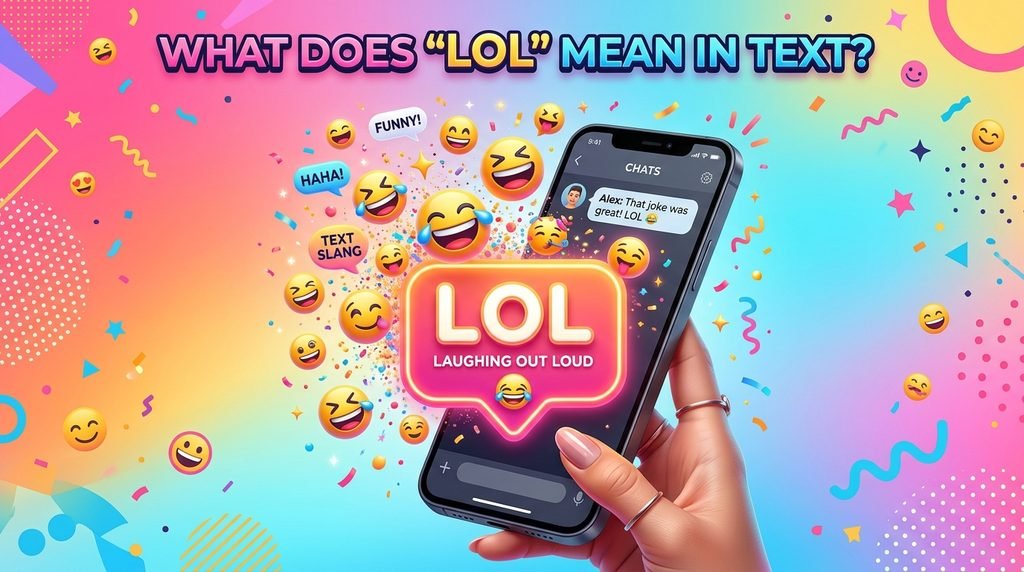
No. LOL does not always mean the person is literally laughing.
This is one of the most important things to understand about LOL slang.
In casual conversations, LOL can mean something closer to:
- “That’s funny.”
- “That made me laugh.”
- “I’m joking.”
- “I find this amusing.”
- “This is awkward but funny.”
- “I’m keeping this conversation light.”
For example:
Person A: I just realized I wore two different socks today.
Person B: LOL
Person B might smile or laugh, but they do not necessarily have to be laughing loudly.
Sometimes people even use LOL automatically at the end of a sentence:
I have so much work to do tonight LOL.
Here, LOL can soften the statement and make it sound more casual.
Other Possible Meanings of LOL
Although “laughing out loud” is overwhelmingly the most common meaning in everyday texting and social media, LOL can have other meanings in different contexts.
For example, LOL may refer to the popular video game League of Legends when people are talking about gaming.
Someone might say:
Do you play LoL?
In a gaming conversation, they may be asking whether you play League of Legends, not whether you are laughing.
Context is therefore important.
LOL as “League of Legends”
Among gamers, “LoL” is commonly used as a shortened name for League of Legends.
For example:
Person A: What game are you playing tonight?
Person B: LoL with my friends.
Here, the meaning is clearly different from “laughing out loud.”
The capitalization may also vary. People can write LOL, lol, or LoL, depending on the context and personal preference.
Why Context Matters
If someone sends:
LOL 😂
they almost certainly mean “laughing out loud.”
But if someone says:
I downloaded LoL yesterday.
they are probably referring to League of Legends.
When you are unsure, look at the surrounding conversation before deciding what the abbreviation means.
What Does LOL Mean on Social Media?
On social media platforms, LOL generally means “laughing out loud.”
You may see it in comments, direct messages, captions, replies, and casual conversations.
For example:
That last video was so unexpected LOL.
Or:
LOL, I wasn’t ready for that.
On social media, LOL can also be used as a reaction to a funny post or comment.
For example:
Someone posted a picture of their cat sleeping inside a shoe.
Comment: LOL this cat is ridiculous.
The abbreviation works in much the same way as it does in texting.
However, social media users also have many other ways to express laughter, including:
- Haha
- Hahaha
- 😂
- LMAO
- LMFAO
- ROFL
- I’m dead
- I’m crying
The choice depends on the person, platform, age group, and style of conversation.
How to Use LOL in a Text
Using LOL is simple. You can put it at the beginning, middle, or end of a casual message.
At the beginning
LOL, I can’t believe you actually did that.
This makes the message start with a humorous reaction.
At the end
I just spilled coffee on my shirt LOL.
This can make an embarrassing situation sound humorous.
In the middle
I LOL just remembered what you said yesterday.
This construction is less common than placing LOL at the beginning or end, but people may use it informally.
As a standalone response
Person A: I just tripped in front of everyone.
Person B: LOL 😂
A standalone LOL can work as a quick reaction.
Still, be careful with a one-word “LOL.” Depending on the situation, it can sometimes feel dismissive or unclear. If the other person is telling you something important, a more thoughtful response may be appropriate.
10 Examples of LOL in Text Conversations
Here are some realistic examples showing how people use LOL in different situations.
Example 1: Reacting to a joke
Person A: Why did the computer go to the doctor? It had a virus.
Person B: LOL 😂
Meaning: Person B thinks the joke is funny.
Example 2: Laughing at yourself
Person A: I spent ten minutes looking for my phone while holding it.
Person B: LOL, that’s something I would do.
Meaning: LOL shows amusement and makes the response friendly.
Example 3: An embarrassing mistake
Person A: I waved back at someone who wasn’t waving at me.
Person B: LOL, that’s awkward.
Meaning: Person B finds the situation funny.
Example 4: Making a message less serious
Person A: I have three assignments due tomorrow LOL.
Meaning: The sender is probably stressed but is using LOL to make the statement sound lighthearted.
Example 5: Teasing a friend
Person A: You really thought you could beat me at chess?
Person B: LOL, just wait.
Meaning: LOL adds a playful, teasing tone.
Example 6: Reacting to a funny story
Person A: My little brother tried to cook and somehow burned the toast.
Person B: LOL how does that even happen?
Meaning: The person finds the story amusing and is asking a playful question.
Example 7: Showing mild amusement
Person A: I forgot my umbrella again.
Person B: LOL, you never learn.
Meaning: The sender is teasing rather than expressing intense laughter.
Example 8: Responding to a funny photo
Person A: Sends a picture of their cat sitting in a sink.
Person B: LOL, your cat is so weird.
Meaning: LOL expresses amusement at the picture.
Example 9: Using LOL after a mistake
Person A: I just sent that email to the wrong person LOL.
Meaning: The sender is acknowledging an embarrassing mistake and treating it humorously.
Example 10: Gaming context
Person A: What are you playing tonight?
Person B: LoL.
Meaning: Here, LoL may mean League of Legends, not “laughing out loud.”
This last example shows why context matters.
How to Respond When Someone Uses LOL
There is no single correct response to LOL. Your reply should depend on what the person said and the relationship you have with them.
If they are responding to a joke, you can simply continue the conversation.
You: I can’t believe I forgot my own password again.
Friend: LOL
You: I really need to write these things down.
You can also respond with another casual expression:
- Haha
- 😂
- Hahaha
- LMAO
- That was funny
- I know, right?
- Seriously 😂
If someone uses LOL while telling you about an embarrassing situation, you might respond sympathetically while keeping the tone light.
Friend: I fell in front of everyone today LOL.
You: Oh no 😂 Are you okay?
The best response depends on whether the conversation is actually funny, serious, awkward, or somewhere in between.
Is LOL Formal or Informal?
LOL is informal.
It is appropriate for casual digital communication, including:
- Text messages
- Chats with friends
- Social media comments
- Direct messages
- Casual online communities
- Informal group conversations
It is generally not appropriate for formal communication such as:
- Job applications
- Business letters
- Academic essays
- Official reports
- Professional documents
- Formal customer communication
For example, you would normally avoid writing:
Thank you for reviewing my application LOL.
Instead, keep professional communication clear and straightforward.
LOL is best understood as internet and texting slang rather than standard formal English.
LOL vs. Haha: What’s the Difference?
LOL and “haha” can both show amusement, but they often have slightly different tones.
LOL is an abbreviation and can feel like a quick reaction or tone marker.
Haha represents laughter more directly in written form.
Compare:
That’s funny LOL.
with:
That’s funny haha.
Both can communicate amusement, but the second may feel more conversational or like a written version of an actual laugh.
Neither one has a fixed emotional strength. The exact tone depends on the person using it.
LOL vs. LMAO
LMAO stands for “laughing my ass off.” It is generally used to express stronger amusement than a simple LOL, although people often use both casually.
For example:
That video was funny LOL.
might show ordinary amusement.
That video was hilarious LMAO.
usually suggests stronger laughter.
Because LMAO contains informal language, it is also best reserved for casual conversations.
LOL vs. ROFL
ROFL stands for “rolling on the floor laughing.”
It is another internet abbreviation associated with strong laughter.
You may see:
- LOL — laughing out loud
- LMAO — laughing very hard
- ROFL — expressing very strong laughter
In modern conversations, LOL is generally more versatile and can be used even when something is only mildly funny.
LOL vs. 😂
The laughing emoji 😂 can serve a similar purpose to LOL.
For example:
You actually did that LOL 😂
Both expressions signal amusement.
People frequently combine them, especially in casual conversations. There is no strict rule saying that you must choose one.
The choice is mostly personal and depends on the style of the conversation.
Can LOL Sound Rude?
Usually, LOL is friendly or playful, but the way it is used can affect how it feels.
Consider:
Person A: I studied all night for this test and still failed.
Person B: LOL.
That response could come across as insensitive because the first person is talking about something upsetting.
Compare it with:
Person A: I accidentally wore my shirt inside out all day.
Person B: LOL, I didn’t even notice!
The second example is clearly more appropriate because the situation is harmless and humorous.
If someone shares something serious, it is better to respond to the substance of their message rather than automatically replying with LOL.
Can LOL Mean “I’m Joking”?
Sometimes, yes.
LOL can help signal that a statement is not meant to be taken completely seriously.
For example:
I’m never talking to you again LOL.
Between close friends, this probably means the person is joking.
Without the LOL, the sentence might sound much more serious:
I’m never talking to you again.
This doesn’t mean LOL always turns a serious statement into a joke. Context and the relationship between the speakers still matter.
How the Meaning of LOL Can Change With Capitalization
You may see LOL written in several ways:
- LOL
- lol
- Lol
- LoL
Usually, the basic meaning remains the same.
However, capitalization can sometimes influence the perceived tone.
LOL in all capital letters may look more emphatic.
lol in lowercase often feels more casual or understated.
For example:
LOL THAT WAS HILARIOUS
looks more energetic than:
lol that was funny
But there is no universal rule. Many people simply use whichever capitalization their keyboard or typing habits produce.
Is LOL Still Used Today?
Yes. LOL remains widely recognizable as an internet and texting abbreviation.
However, the way people use it has changed over time. In earlier internet conversations, LOL was often intended to communicate actual laughter. Today, it can also function as a casual tone marker.
Someone might add “lol” to a message simply because it feels natural in their texting style.
For example:
I don’t know what I’m doing lol
may not mean the person is laughing. It can simply make the statement sound relaxed and conversational.
This broader use is common with many forms of internet slang. Their meaning is often shaped by context rather than a strict dictionary definition.
FAQs:
What does LOL mean in text?
LOL usually means “laughing out loud.” People use it to show that something is funny or amusing. In casual texting, it can also make a message sound more relaxed, friendly, or playful.
What does LOL stand for?
LOL stands for “laughing out loud.” It is formed from the first letters of the three words: Laughing, Out, and Loud.
Is LOL slang?
Yes. LOL is commonly considered internet and texting slang. It is widely understood in casual digital communication but is generally unsuitable for formal writing.
What does LOL mean on Snapchat, TikTok, or Instagram?
On social media platforms such as Snapchat, TikTok, and Instagram, LOL usually means “laughing out loud.” It can be used in comments, captions, direct messages, or replies to show amusement.
Does LOL mean the person is actually laughing?
Not necessarily. LOL can indicate genuine laughter, but it can also simply mean “that’s funny,” “I’m joking,” or “I’m keeping this message light.” The surrounding conversation helps determine the intended tone.
How do you use LOL in a sentence?
You can use LOL after a funny statement or at the beginning of a reaction. For example: “LOL, I can’t believe you actually did that!” You can also use it at the end: “I forgot my keys again LOL.”
How should I respond when someone says LOL?
There is no required response. If the conversation is funny, you can reply with “haha,” “😂,” another joke, or continue the conversation. If the person is discussing something serious, respond to the actual situation rather than focusing on LOL.
Can LOL mean something other than laughing out loud?
Yes. In gaming conversations, LoL can refer to League of Legends. In most ordinary texting conversations, however, LOL means “laughing out loud.” Always consider the surrounding context.
Similar Slang Words and Abbreviations
If you are learning texting slang, you may also encounter these abbreviations:
- LOL — Laughing out loud
- LMAO — Laughing my ass off
- LMFAO — Laughing my freaking/fucking ass off
- ROFL — Rolling on the floor laughing
- OMG — Oh my God
- IDK — I don’t know
- BTW — By the way
- TBH — To be honest
- FYI — For your information
- BRB — Be right back
- IMO — In my opinion
- IKR — I know, right?
These expressions can make online conversations much shorter, but their meanings can also depend on context.
If you’re unfamiliar with one, looking at the whole message is usually more useful than interpreting the abbreviation by itself.
Final Takeaway:
So, what does LOL mean in text? In most cases, LOL means “laughing out loud.”
It is a casual internet abbreviation used to show amusement, react to something funny, or make a message feel more playful and relaxed.
The important thing to remember is that LOL does not always mean someone is literally laughing out loud. In modern texting, it can simply soften a message, signal that something is a joke, or add a friendly tone.
For example, “That was hilarious LOL” clearly expresses amusement, while “I forgot my homework again LOL” may be more about laughing at an embarrassing mistake.
Context is the key. If the conversation is about gaming, “LoL” could instead refer to League of Legends.
In everyday texts, comments, and social media conversations, however, “laughing out loud” is the standard meaning.
Once you understand how people use LOL in different situations, it becomes much easier to read the tone behind casual online conversations.
Discover more post:
| https://wordfigures.com/what-does-brb-mean-in-text/ |
| https://wordfigures.com/what-does-ttyl-mean-in-text/ |
| https://wordfigures.com/what-does-omg-mean-in-text/ |

Arabella is a passionate English language writer and content creator with over 5 years of experience in writing, researching, and explaining language-related topics in a simple, engaging, and easy-to-understand way.
Related Post
What Does What Does ML Mean in Text? Real Meaning Examples
If someone sends you a message that says ml you might wonder what they mean.…
2 thoughts on “What Does LOL Mean in Text? Meaning Uses and Examples”