
What Does ROFL Mean in Text? Meaning, Examples
wordfigures.com >> Best meaning in text>> What Does ROFL Mean in Text? Meaning, Examples
What Does ROFL Mean in Text? Meaning, Examples
If you’ve ever received a message containing ROFL and wondered what the letters mean, you’re not alone.
Internet slang can look confusing at first, especially when someone uses an abbreviation without explaining it.
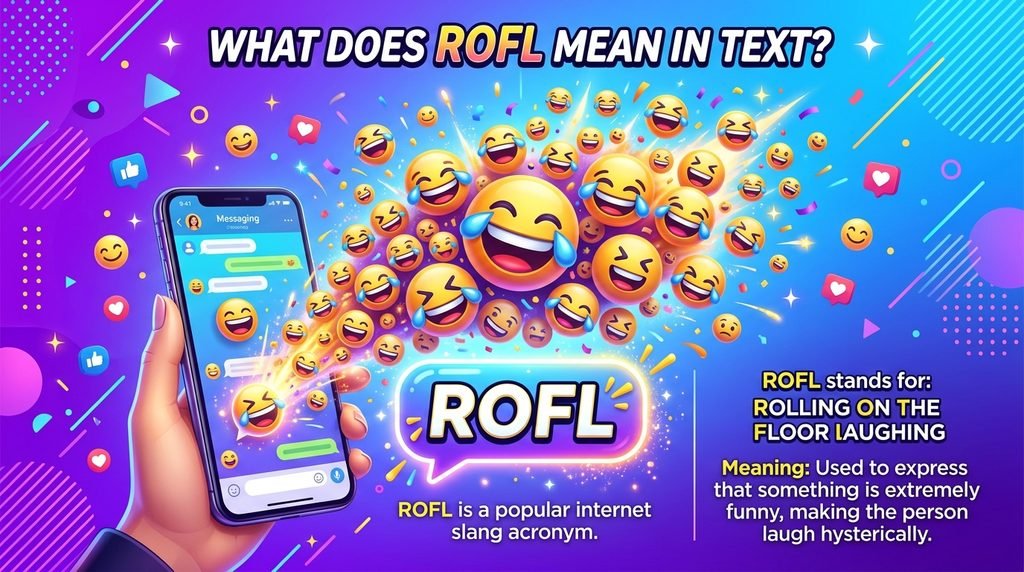
So, what does rofl mean in text? In most cases, ROFL means “Rolling On the Floor Laughing.”
It is used when someone finds something extremely funny.
Quick Answer:
ROFL stands for “Rolling On the Floor Laughing.” In texting and online conversations, it means that something is extremely funny. It is a stronger way of showing laughter than simply saying “LOL.” Someone might reply with “ROFL” when a joke, funny picture, story, or unexpected situation makes them laugh a lot.
The phrase is usually playful, informal, and friendly.
What Does ROFL Mean in Text?
When someone types ROFL in a text message, they are usually saying that they find something very funny.
The abbreviation comes from the phrase “Rolling On the Floor Laughing.” Of course, most people aren’t literally rolling around on the floor. It is an exaggerated expression used to communicate strong amusement.
For example:
Person A: I walked into the kitchen and forgot why I was there.
Person B: ROFL, I do that all the time.
Here, Person B isn’t necessarily imagining Person A physically rolling on the floor. They are simply expressing that the situation is very funny or relatable.
ROFL is commonly used in:
- Text messages
- Group chats
- Social media comments
- Online gaming chats
- Direct messages
- Internet forums
- Casual conversations
The exact feeling can depend on the context. Sometimes ROFL means genuine laughter. Other times, it can be used playfully or dramatically to make a reaction sound more humorous.
What Does ROFL Stand For?
ROFL stands for:
R — Rolling
O — On
T — The
F — Floor
L — Laughing
So the complete expression is:
Rolling On The Floor Laughing
It belongs to the large family of internet and texting abbreviations that developed as people looked for quick ways to communicate emotions online.
Unlike a normal sentence, ROFL lets someone communicate a reaction with just four letters.
For example:
“That video was ROFL.”
The writer is essentially saying:
“That video made me laugh really hard.”
The Most Common Meaning of ROFL
The overwhelmingly common meaning of ROFL in casual online communication is “Rolling On The Floor Laughing.”
It indicates strong amusement.
Imagine someone sends you a story about accidentally sending a private message to the wrong person. If the story is funny, you might respond:
“ROFL 😂”
That response tells them you found the situation hilarious.
ROFL is generally stronger than LOL, although people don’t always use these abbreviations according to strict levels of laughter.
A rough comparison might look like this:
- LOL — That is funny.
- LMAO — That is really funny.
- ROFL — That is extremely funny.
- ROFLMAO — An exaggerated way of saying something is incredibly funny.
These aren’t official rules. People often use LOL, LMAO, and ROFL casually, and their meanings can overlap.
Does ROFL Literally Mean You’re Rolling on the Floor?

Not usually.
The expression is figurative. When someone types ROFL, they normally aren’t claiming that they have actually fallen onto the floor because they are laughing.
It’s similar to saying:
“I’m dying laughing.”
That doesn’t necessarily mean anything dangerous has happened. It’s simply an exaggerated way of expressing amusement.
For example:
My little brother tried to make pancakes and somehow made a pancake shaped like a shoe.
ROFL 😂
is expressing strong amusement about the story.
Understanding this makes ROFL easier to interpret. Think of it as an emotional reaction rather than a literal description of someone’s physical position.
What Does ROFL Mean in Texting?
In texting, ROFL means that the sender thinks something is extremely funny.
It can appear by itself:
“ROFL”
or as part of a longer message:
“ROFL, I can’t believe you actually said that.”
It can also be combined with emojis:
“ROFL 😂”
“ROFL 🤣”
The abbreviation works particularly well in casual conversations because texting often relies on short expressions to communicate emotions quickly.
For example:
Friend: I just waved back at someone who wasn’t waving at me.
You: ROFL 😭
Here, ROFL shows that you find the embarrassing situation funny.
The sender doesn’t necessarily need to explain why they are laughing. The surrounding conversation usually provides enough context.
What Does ROFL Mean on Social Media?
On social media, ROFL has essentially the same meaning: “Rolling On The Floor Laughing.”
You may see it in:
- Facebook comments
- Instagram comments
- TikTok comments
- X posts and replies
- Reddit discussions
- YouTube comments
- Group chats and social communities
Someone might comment “ROFL” underneath a funny video, joke, meme, or unexpected post.
For example:
Video caption: “My cat waited until I finished cleaning the room, then knocked everything off the table.”
Comment: “ROFL 😂”
The person is saying that the video or story is extremely funny.
On social media, ROFL can also be used as part of a longer reaction:
“ROFL, the ending was completely unexpected.”
The meaning doesn’t substantially change from texting to social media.
How to Use ROFL in a Text
Using ROFL is easy if you’re having a casual conversation and want to show strong amusement.
1. Use it after a funny joke
Friend: Why did the computer go to the doctor? Because it had a virus.
You: ROFL 😂
This shows that you found the joke funny.
2. Use it after a funny story
Friend: I accidentally called my teacher “Mom” in front of everyone.
You: ROFL, that’s so embarrassing.
Here, ROFL emphasizes your reaction to the story.
3. Use it after seeing a funny picture
Friend: sends a ridiculous picture
You: ROFL 🤣
The abbreviation can stand alone because the picture provides the context.
4. Use it when something unexpected happens
Friend: He walked into the room wearing two different shoes.
You: ROFL, seriously?
Here, ROFL communicates surprise and amusement.
5. Use it when teasing a friend
Friend: I practiced my dance for three hours.
You: ROFL, and you still forgot the first step?
This can be friendly teasing, depending on the relationship and tone.
ROFL Text Conversation Examples
The best way to understand slang is to see how people actually use it. Here are several realistic examples.
Example 1: A Funny Mistake
Person A: I just sent my grocery list to my boss instead of my coworker.
Person B: ROFL 😂 What did they say?
Explanation:
Person B finds the mistake funny and uses ROFL to show strong amusement.
Example 2: An Embarrassing Moment
Person A: I walked into the wrong classroom and sat down before realizing it.
Person B: ROFL. Did anyone notice?
Explanation:
ROFL shows that Person B thinks the situation is funny, even though it was probably embarrassing for Person A.
Example 3: A Funny Video
Person A: Did you see that video of the dog trying to catch the bubbles?
Person B: Yes! ROFL 🤣
Explanation:
Person B uses ROFL to emphasize how funny they found the video.
Example 4: A Friend’s Joke
Person A: You need a GPS to find your own bedroom.
Person B: ROFL, okay, that’s actually true.
Explanation:
Here, ROFL is a reaction to friendly teasing.
Example 5: Unexpected News
He said he was going to wake up early today.
And?
He woke up at 2 p.m.
ROFL 😂
Explanation:
Person B finds the situation funny because it completely contradicts what the person originally planned.
Example 6: Group Chat Humor
Who ate the last slice of pizza?
Not me.
You literally posted a picture of yourself eating it.
ROFL, okay, you got me.
Explanation:
Here, ROFL helps keep the conversation playful after being caught.
Example 7: A Funny Autocorrect
Person A: I meant to type “see you soon” but autocorrect changed it to “see you spoon.”
Person B: ROFL 😭
Explanation:
Person B uses ROFL because the autocorrect mistake is amusing.
Example 8: A Gaming Conversation
Player A: I spent ten minutes looking for my character, then realized I was controlling the wrong one.
Player B: ROFL 😂
Explanation:
In a gaming chat, ROFL can be used just like it is in ordinary texting.
Example 9: A Self-Deprecating Joke
I tried cooking without a recipe.
How did it go?
The smoke alarm gave me a standing ovation.
ROFL.
Explanation:
Person B is laughing at the exaggerated description of the failed cooking attempt.
Example 10: A Meme
Person A: sends a meme about Monday mornings
Person B: ROFL, this is literally me every Monday.
Explanation:
ROFL expresses strong amusement, while the rest of the message explains why the meme feels relatable.
Can ROFL Have Different Meanings?
In ordinary texting and social media, ROFL almost always means “Rolling On The Floor Laughing.”
However, abbreviations can occasionally have different meanings in specialized environments. Someone working in a particular industry, organization, game, or technical community might use the same letters differently.
That’s why context matters.
If you’re having a normal conversation with a friend and they respond:
“ROFL 😂”
you can safely understand it as an expression of laughter.
If you encounter ROFL in a technical document, workplace abbreviation list, username, or specialized discussion, don’t automatically assume it has the texting meaning. Look at the surrounding words and context.
For everyday internet slang, though, Rolling On The Floor Laughing is the meaning you are most likely to encounter.
ROFL vs. LOL: What’s the Difference?
ROFL and LOL are both expressions of laughter, but they can suggest different levels of amusement.
LOL stands for “Laughing Out Loud.”
ROFL stands for “Rolling On The Floor Laughing.”
For example:
Friend: I forgot my password again.
You: LOL.
This might indicate that you found the situation mildly funny.
But:
Friend: I forgot my password, reset it, and immediately forgot the new one.
You: ROFL 😂
The second response sounds more exaggerated and strongly amused.
That said, there is no official scale of laughter. People often use LOL even when they are genuinely laughing hard, while others may use ROFL casually.
ROFL vs. LMAO
Another common abbreviation is LMAO, which means “Laughing My Ass Off.”
Like ROFL, LMAO is informal and expresses strong amusement.
For example:
“That was hilarious. LMAO.”
and:
“That was hilarious. ROFL.”
can communicate almost the same basic idea.
The choice often depends on personal style.
Some people prefer ROFL because it sounds playful. Others use LMAO because it is common in casual internet conversations.
Is ROFL Slang?
Yes. ROFL is internet and texting slang.
More specifically, it is an initialism formed from the first letters of the words in “Rolling On The Floor Laughing.”
It became popular as online communication developed and people needed quick ways to express emotions through text.
Because ROFL is informal, it fits naturally in casual digital conversations but generally isn’t appropriate for formal writing.
For example, this is perfectly normal:
“ROFL, that meme is hilarious.”
But you probably wouldn’t write:
“ROFL, thank you for your professional email.”
in a formal business email.
The context and relationship between the people communicating matter.
Is ROFL Formal or Informal?
ROFL is informal.
You can comfortably use it with:
- Friends
- Family members
- Close coworkers
- Online friends
- Gaming groups
- Social media followers
- People you’re having a casual conversation with
It’s generally better to avoid it in:
- Formal business emails
- Academic assignments
- Job applications
- Official documents
- Professional reports
- Formal customer communications
Instead of writing ROFL in a professional situation, you could say:
- “That’s very funny.”
- “That made me laugh.”
- “That’s hilarious.”
- “I found that amusing.”
The important thing is to match your language to the situation.
Can ROFL Sound Sarcastic?
Yes, depending on the context.
Although ROFL normally communicates genuine amusement, people sometimes use it sarcastically.
For example:
Person A: I spent three hours fixing the problem and discovered I hadn’t plugged it in.
Person B: ROFL.
This could be genuine laughter.
But imagine someone says:
Person A: I got a perfect score because I studied all night.
Person B: ROFL, sure you did.
Here, the phrase may carry a sarcastic tone. The second message suggests that Person B doesn’t necessarily believe Person A.
The same abbreviation can therefore have different emotional shades depending on punctuation, wording, emojis, and the relationship between the speakers.
How Should You Respond When Someone Says ROFL?
There’s no single correct response.
If someone sends you ROFL, they’re usually reacting positively to something funny. You can continue the conversation naturally.
If you want to keep joking
Them: ROFL 😂
You: I knew you’d find that funny.
If you want to ask what they found funny
Them: ROFL
You: What? 😂
If you’re laughing too
Them: ROFL
You: Same 😂
If you’re telling a funny story
Them: ROFL
You: And that’s not even the funniest part.
You don’t have to respond with another abbreviation. A normal sentence, emoji, or follow-up question works just as well.
Can You Write ROFL in Capital Letters or Lowercase?
Yes.
You may see:
- ROFL
- rofl
- RoFL
- rofl 😂
The meaning is generally the same.
Capital letters can sometimes make the reaction look more energetic, while lowercase can feel more relaxed.
For example:
“ROFL 😂”
may look more emphatic than:
“rofl”
But this isn’t a strict rule. People type internet slang in whatever style feels natural to them.
ROFL With Emojis
ROFL is often paired with laughing or crying emojis.
Common combinations include:
ROFL 🤣
The emojis add emotional context.
For example, the loudly laughing emoji 🤣 can reinforce the idea that the person found something extremely funny.
The 😭 emoji can also appear after funny comments. In internet slang, it doesn’t necessarily mean sadness. Depending on context, it can communicate that something is so funny that the person is overwhelmed with laughter.
For example:
“You really wore that to the party? ROFL 😭”
The overall message is playful rather than sad.
ROFL in Group Chats
ROFL is especially common in group chats because conversations can move quickly.
Someone might post a joke, funny image, embarrassing story, or unexpected comment, and another person can simply respond:
“ROFL 😂”
That short response lets everyone know they found the message funny without interrupting the conversation with a long explanation.
In fast-moving chats, short reactions like ROFL, LOL, LMAO, and emojis are useful because they communicate an emotional response almost instantly.
ROFL in Online Gaming
Gamers also use ROFL in casual chat.
For example:
Player A: I jumped off the map by accident.
Player B: ROFL 😂
Or:
Player A: I spent five minutes searching for an enemy who was standing directly behind me.
Player B: ROFL.
The meaning is still “Rolling On The Floor Laughing.” The gaming context simply provides the situation that caused the laughter.
Similar Slang Words and Abbreviations
If you’re learning internet slang, ROFL is just one of many expressions related to laughter.
LOL
Meaning: Laughing Out Loud
Usually used to show that something is funny.
LMAO
Meaning: Laughing My Ass Off
An informal expression of strong amusement.
LMFAO
Meaning: Laughing My F***ing Ass Off
A more intense and profane version of LMAO.
LOLZ
A playful variation of LOL that can sound intentionally silly or internet-style.
😂
The face-with-tears-of-joy emoji is commonly used to show that something is funny.
🤣
The rolling-on-the-floor-laughing emoji can strongly reinforce the same feeling associated with ROFL.
HAHA
A simple written expression of laughter. Depending on the number of “ha”s and context, it can indicate anything from mild amusement to strong laughter.
The important thing is that these expressions aren’t exact substitutes in every situation. People use them according to their personal texting style.
FAQs:
What does ROFL mean in text?
ROFL means “Rolling On The Floor Laughing.” In text messages, it is used to show that something is extremely funny. It is informal and commonly appears in conversations with friends, family, online communities, and other casual settings.
What does ROFL stand for?
ROFL stands for Rolling On The Floor Laughing. It is an internet slang abbreviation used to communicate strong amusement.
Is ROFL slang?
Yes. ROFL is informal internet and texting slang. It is appropriate for casual conversations but is generally not suitable for formal documents, academic writing, or professional communication.
Is ROFL stronger than LOL?
Generally, ROFL is intended to express stronger amusement than LOL. However, people use both abbreviations differently, so there is no official rule about how much laughter each one represents.
What does ROFL mean on social media?
On social media, ROFL usually means “Rolling On The Floor Laughing.” Someone may use it in response to a funny video, meme, comment, story, image, or post.
How do you use ROFL in a sentence?
You can use ROFL as a reaction or inside a casual message. For example: “ROFL, I can’t believe you actually did that!” It tells the other person that you find the situation very funny.
How should I respond to ROFL?
You can respond naturally depending on the conversation. You might continue the joke, send a laughing emoji, say “same,” or ask what they found funny. There isn’t a specific response you must use.
Is ROFL appropriate for work?
ROFL is generally too informal for professional communication. With close coworkers in a casual chat, it may be acceptable depending on the workplace culture, but formal emails and documents are better served by standard language.
Final Takeaway:
So, what does rofl mean in text? In everyday texting and online conversations, ROFL means “Rolling On The Floor Laughing.”
It is a playful way to tell someone that you find something extremely funny.
You might see it after a joke, funny story, meme, video, embarrassing moment, or unexpected comment.
It can appear alone, such as “ROFL,” or alongside other words and emojis, such as “ROFL 😂.”
ROFL is closely related to expressions like LOL and LMAO, but it is usually used to communicate a stronger or more exaggerated reaction to something funny.
The main thing to remember is context. ROFL is informal, so it works best in casual digital conversations rather than formal writing.
If a friend sends you “ROFL,” they’re almost certainly telling you that your message made them laugh.
Once you know what the abbreviation stands for, it becomes one of the easier pieces of internet slang to understand.
Discover more post:
| https://wordfigures.com/what-does-omg-mean-in-text/ |
| https://wordfigures.com/what-does-lol-mean-in-text/ |
| https://wordfigures.com/what-does-lmao-mean-in-text/ |

Anastasia is an experienced English language and literary content writer with over 5 years of experience. As an author at WordFigures.com, she writes about metaphors, similes, figures of speech, symbolism, literary devices, and English expressions. Her goal is to make complex language concepts simple, clear, and useful through well-researched explanations and practical examples.
Related Post
What Does RN Mean in Text? Meaning, Examples
If you've received a text containing “RN” and wondered what the person meant, you're not…
2 thoughts on “What Does ROFL Mean in Text? Meaning, Examples”