
What Does OOP Mean in Text? Real Meaning Examples
wordfigures.com >> Best meaning in text>> What Does OOP Mean in Text? Real Meaning Examples
What Does OOP Mean in Text? Real Meaning Examples
If someone sends you oop in a text message, you might wonder what they are trying to say.
Is it a typo? Is it an abbreviation? Or does it have some hidden meaning?
In most casual conversations oop is an informal expression used to show surprise, embarrassment, awkwardness, or a sudden reaction to something that just happened or was said.
You may see it in text messages, comments, TikTok captions, Instagram posts, Snapchat chats, and other social media conversations.
Depending on the situation oop can mean something like “Oops,” “Oh!” or “Well, that happened.”
For example:
Friend: “I accidentally sent that message to my boss instead of you.”
You: “Oop 😭”
Here, “oop” is a playful reaction to an awkward mistake.
But there is more to the expression than simply shortening the word oops. Its meaning can change slightly depending on the conversation, punctuation, emojis, and tone.
Let’s take a closer look.
What Does “OOP” Mean in Text?
In texting and online conversations, “oop” is generally an expression of surprise, awkwardness, embarrassment, or mild shock.
It is often used when someone notices something unexpected or when a person makes a small mistake.
For example:
“Oop, I forgot we had homework.”
In this sentence, “oop” expresses a quick realization.
Someone might also write:
“Oop 👀”
This can suggest that the person has noticed something interesting, surprising, or potentially embarrassing.
Another common use is simply:
“Oop…”
The three dots can make the expression feel more awkward or dramatic.
The important thing to remember is that “oop” doesn’t have one strict definition. Internet slang is highly dependent on context, and the same expression can communicate different emotions in different conversations.
Is “Oop” the Same as “Oops”?
Not exactly, although they are closely related.
“Oops” is the traditional English expression used when someone makes a mistake or realizes something went wrong.
For example:
“Oops, I dropped my phone.”
“Oop” is a more internet-style version that is often used casually and playfully.
For example:
“Oop, you weren’t supposed to see that.”
The spelling makes the expression feel more like an online reaction than a formal apology.
“Oop” can also be used when the speaker isn’t necessarily admitting that they made a mistake. Sometimes they are simply reacting to something unexpected.
For example:
“She just told everyone his secret.”
“Oop.”
In this situation, “oop” is closer to “Oh wow” or “Well, that’s awkward.”
So while “oop” can come from “oops,” online users have developed additional ways to use it.
Why Do People Say “Oop” Instead of “Oops”?
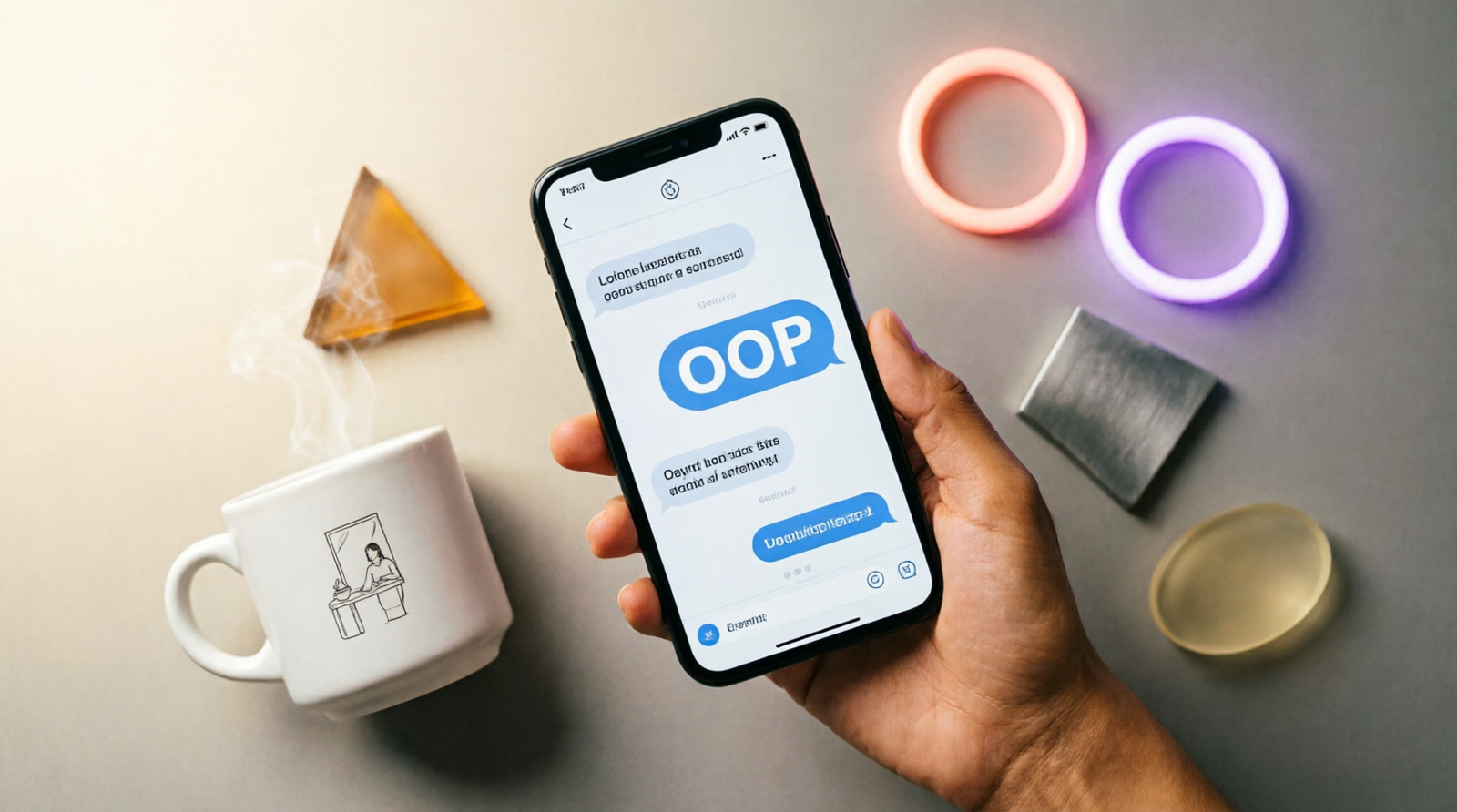
Online communication is informal. People often change words to make their messages shorter, funnier, or more expressive.
“Oop” has a distinctive conversational feeling.
Compare these:
“Oops, I sent the wrong picture.”
and:
“Oop, wrong picture 😭”
The second version feels more casual and playful.
The expression can also make a message sound less serious. If someone makes a tiny mistake, saying “oop” can turn the moment into a joke instead of making it feel dramatic.
That’s one reason internet slang spreads so easily. People aren’t always looking for new words with completely new meanings. Sometimes they simply modify familiar expressions to create a particular tone.
Common Meanings of “Oop” in Texting
Although context matters, “oop” commonly communicates one of several reactions.
1. Surprise
Someone may use “oop” after hearing unexpected information.
For example:
“Oop, I didn’t know they were dating.”
Here, the speaker is expressing surprise.
It could be similar to:
- “Oh!”
- “Wow!”
- “Really?”
- “I didn’t know that.”
2. Embarrassment
“Oop” can also be used when someone does something embarrassing.
For example:
“I waved at someone who wasn’t waving at me. Oop.”
The expression makes the embarrassing situation sound humorous.
3. Realizing a Mistake
This is probably the closest meaning to the traditional “oops.”
For example:
“Oop, I forgot to attach the file.”
The speaker has just realized they made a small mistake.
4. Awkwardness
Sometimes “oop” means that a situation has suddenly become uncomfortable.
For example:
“Oop, they’re arguing in the group chat.”
Here, “oop” can mean something like:
“Well, this just got awkward.”
5. Playful Shock
People also use “oop” when they see something unexpected but funny.
For example:
“He actually posted the screenshot. Oop 😂”
The expression adds a playful reaction to the situation.
What Does “Oop” Mean on Social Media?
Social media has played a major role in making expressions such as “oop” common.
On platforms where conversations happen quickly, users often communicate through short reactions rather than complete sentences.
You might see:
“Oop 👀”
“Oop—”
“oop lol”
“OOP 😭”
“And I oop…”
Each version can have a slightly different tone.
For example, “oop 👀” may suggest that the person has noticed some drama or surprising information.
“OOP 😭” can indicate stronger amusement or disbelief.
“oop…” can feel more awkward or hesitant.
And “OOP” in capital letters may emphasize the reaction.
The surrounding conversation is usually more important than the capitalization itself.
What Does “And I Oop” Mean?
You may also come across the phrase “and I oop” online.
This became particularly recognizable through internet culture and is often used humorously when someone suddenly encounters something surprising, awkward, or unexpected.
For example:
“I opened the group chat and saw them arguing. And I oop…”
In casual internet language, the phrase can express the feeling of being caught off guard.
It is often used dramatically for comedic effect.
Someone might write:
“And I oop—there goes my weekend.”
The phrase doesn’t necessarily describe a literal event. It can simply make a reaction sound exaggerated and funny.
Examples of “Oop” in Text Messages
Seeing real examples is one of the easiest ways to understand internet slang.
Example 1: Forgetting Something
Person A: “Did you bring your assignment?”
Person B: “Oop…”
Here, “oop” means they just realized they forgot it.
Example 2: Unexpected News
Person A: “Sarah and Mike broke up.”
Person B: “Oop, what happened?”
Here, “oop” shows surprise and invites more information.
Example 3: An Awkward Situation
Person A: “I accidentally called my teacher ‘Mom.’”
Person B: “OOP 😭”
This expresses amusement and sympathy at the same time.
Example 4: Someone Reveals Too Much
Person A: “He said he doesn’t like the party.”
Person B: “Oop 👀”
The response suggests that the information might create drama.
Example 5: A Small Mistake
Person A: “I sent the message to the wrong group.”
Person B: “Oop lol.”
Here, “oop” is a lighthearted response to the mistake.
What Does “Oop” Mean From a Girl?
If a girl sends you “oop,” the basic meaning doesn’t automatically change because of her gender.
The context matters more than who sent it.
She might use it to express:
- surprise
- embarrassment
- amusement
- awkwardness
- realization
- playful shock
For example:
“Oop, I wasn’t supposed to say that.”
This clearly suggests she revealed something accidentally.
On the other hand:
“Oop 👀”
might be a playful reaction to something interesting.
It’s better not to assume that “oop” has a romantic meaning simply because someone you like sent it.
The surrounding conversation tells you much more.
What Does “Oop” Mean From a Guy?
The same principle applies when a guy uses “oop.”
He might be saying:
“Oops, I made a mistake.”
Or:
“Wow, that’s unexpected.”
Or:
“Well, this is awkward.”
For example:
“Oop, my bad.”
This is usually just a casual way of acknowledging a mistake.
If you’re trying to understand someone’s intention, look at the entire message rather than interpreting “oop” on its own.
Does “Oop” Mean “Sorry”?
Sometimes, but not necessarily.
If someone says:
“Oop, sorry!”
then the expression is clearly connected to an apology.
However, if someone says:
“Oop 👀”
they aren’t necessarily apologizing.
They may simply be reacting to something unexpected.
That’s why translating “oop” directly as “sorry” isn’t always accurate.
A better approach is to think of it as a reaction word whose exact meaning depends on the situation.
What Does “Oop” Mean With Different Emojis?
Emojis can change the feeling of the expression.
“Oop 😂”
Usually suggests that something unexpected is funny.
Example:
“He forgot his own birthday. Oop 😂”
“Oop 😭”
Often means amused disbelief, embarrassment, or dramatic surprise.
Example:
“I just realized I studied the wrong chapter. Oop 😭”
“Oop 👀”
Can suggest interest, curiosity, or noticing drama.
Example:
“She just posted about him. Oop 👀”
“Oop 😳”
Usually suggests embarrassment, surprise, or being caught off guard.
Example:
“He just said he likes you. Oop 😳”
“Oop…”
Often sounds awkward or hesitant.
Example:
“Oop… I think that’s your ex.”
The emoji isn’t required, but it can make the intended emotion easier to understand.
“Oop” vs. “Oops”
These two expressions are similar but aren’t always interchangeable.
| Expression | Common feeling | Example |
|---|---|---|
| Oops | Mistake or accident | “Oops, I broke it.” |
| Oop | Casual surprise or realization | “Oop, didn’t expect that.” |
| OOP | Stronger or dramatic reaction | “OOP, what happened?” |
| Oop 👀 | Interest or surprise | “Oop 👀 tell me more.” |
| Oop 😭 | Amusement or embarrassment | “Oop 😭 I forgot.” |
The biggest difference is tone.
“Oops” is a normal English expression that has been around for a long time.
“Oop” feels more connected to informal online conversation and social media culture.
Is “Oop” a Formal Word?
No.
“Oop” is informal internet slang. You generally wouldn’t use it in a professional email, academic essay, formal letter, or official document.
For example, instead of writing:
“Oop, I forgot to submit the report.”
in a professional setting, you would normally write:
“I apologize. I forgot to submit the report.”
The casual version is appropriate for friends and informal online conversations.
Knowing when not to use slang is just as important as understanding it.
How Should You Respond When Someone Says “Oop”?
Your response depends on what happened.
If they say:
“Oop, I forgot.”
You might respond:
“Lol, it happens.”
If they say:
“Oop 👀”
You could say:
“What? 😂”
Or:
“What did you notice?”
If they say:
“Oop, sorry!”
You can simply say:
“No worries!”
There isn’t one required response because “oop” isn’t a question or a fixed phrase. It’s mainly a reaction.
Is “Oop” Rude?
Usually, no.
“Oop” is generally harmless and playful.
However, tone matters. If someone responds to serious news with:
“Oop 😂”
it could come across as insensitive.
Likewise, if someone is upset and you respond with slang that sounds dismissive, they may misunderstand your intention.
So while “oop” itself isn’t normally rude, the situation determines whether it is appropriate.
Why Is “Oop” So Popular Online?
Internet language evolves quickly.
People communicate through short messages, comments, memes, videos, GIFs, and emojis. As a result, expressions that can communicate a feeling in just a few characters become useful.
“Oop” is especially convenient because it can express several reactions without requiring a full sentence.
Instead of writing:
“I am surprised and slightly embarrassed that this happened.”
someone can simply write:
“Oop 😭”
The reader usually understands the emotional tone from the context.
Internet slang also changes because people enjoy making communication playful. Small changes in spelling can make an ordinary expression feel more humorous or dramatic.
Does “Oop” Have Anything to Do With “OOP” in Technology?
This is an important distinction.
In technology and programming, OOP commonly stands for Object-Oriented Programming.
That is completely different from the casual texting expression “oop.”
For example:
“I’m learning OOP in Python.”
Here, OOP means Object-Oriented Programming, not surprise or embarrassment.
So if you see “OOP” in a programming discussion, don’t automatically interpret it as internet slang.
The surrounding topic tells you which meaning is intended.
Texting Context
“Oop, I forgot my keys.”
Meaning: a casual reaction.
Programming Context
“OOP makes it easier to organize certain programs.”
Meaning: Object-Oriented Programming.
This is a good example of why context is essential when interpreting abbreviations and slang.
Other Meanings of OOP
Depending on the environment, OOP can have meanings beyond texting and programming.
For example, an abbreviation can be used differently in gaming, business, education, online communities, or specific organizations.
That’s why you shouldn’t assume every appearance of “OOP” has the same definition.
If you’re reading a message and aren’t sure what someone means, consider:
- What are they talking about?
- Is the conversation casual?
- Are they reacting to something?
- Is the term capitalized?
- Are there emojis nearby?
- Does the surrounding sentence provide a clue?
These questions can usually help you figure it out.
Is “Oop” Still Used?
Yes. “Oop” continues to appear in casual digital communication, particularly in social media conversations and informal messaging.
However, internet slang changes constantly. Some expressions become extremely popular for a period and then gradually become less common.
You may also see variations in spelling, capitalization, punctuation, and emoji use.
For example:
oop
Oop
OOP
oop—
oop 😭
oop 👀
The basic idea remains similar, but the presentation changes with the conversation.
When Should You Use “Oop”?
“Oop” works best when you’re talking casually with people who understand internet slang.
It’s suitable for:
- texting friends
- casual group chats
- social media comments
- memes
- informal messages
- playful conversations
For example:
“Oop, I just realized I sent that to the wrong person.”
That’s perfectly natural in a casual chat.
But you probably shouldn’t use it in:
- formal emails
- school assignments
- job applications
- official reports
- business documents
- professional correspondence
A simple rule is: if you would normally use “oops” in a casual conversation, “oop” may work as a more playful online version.
How to Understand the Tone Behind “Oop”
The word itself gives you only part of the information.
Look at what comes before and after it.
Compare:
“Oop, I forgot.”
This sounds like a simple realization.
Now compare:
“OOP 👀”
This sounds much more dramatic and curious.
And:
“oop…”
sounds quieter and potentially awkward.
Finally:
“OOPPPP 😭😭”
is likely exaggerated for comedic effect.
The number of letters, capitalization, punctuation, and emojis can all change the emotional tone.
That’s common in digital communication because people don’t have facial expressions or voice tone to communicate emotion. They often use spelling and punctuation to compensate.
FAQs:
What does oop mean in a text message?
“Oop” is usually a casual reaction showing surprise, embarrassment, awkwardness, or realization. It can sometimes function as a playful version of “oops.”
Is oop short for oops?
It can be. In online conversations, “oop” is closely related to “oops,” but people also use it more broadly as a reaction to unexpected or awkward situations.
Does oop mean oh?
Sometimes it can communicate a reaction similar to “oh!” But its exact meaning depends on the context.
What does oop 👀 mean?
“Oop 👀” often suggests that someone noticed something interesting, surprising, or potentially dramatic. It can have a playful “I saw that” feeling.
What does oop 😭 mean?
“Oop with a crying emoji often expresses amusement, embarrassment, disbelief, or dramatic surprise. The exact meaning depends on what happened.
Is oop slang?
Yes. “Oop” is informal internet and texting slang rather than standard formal English.
Can oop be sarcastic?
Yes. Someone can use it sarcastically, especially when reacting to an awkward or dramatic situation.
Is oop offensive?
Generally, no. It’s normally a harmless informal expression. However, using it inappropriately during a serious situation could make someone feel that you’re not taking them seriously.
What does OOP mean in programming?
In programming, OOP usually means Object-Oriented Programming. This is different from the casual texting expression “oop.”
Final Thoughts:
So, what do oop mean in text?
In everyday texting and social media, oop is generally a playful reaction to something surprising, awkward embarrassing or unexpected.
It can sometimes mean oops but it can also function more like oh wow or well, that’s awkward.
The key is context. Internet slang doesn’t always have a single dictionary-style definition.
The words around it, the punctuation, capitalization, and emojis often tell you what the person really means.
One final thing to remember: oop in a casual text is not the same as OOP in a technical conversation.
If you’re discussing programming, OOP probably means Object-Oriented Programming.
For casual messaging, though, if someone suddenly replies oop they’re probably reacting to something that caught them off guard. 😄
Discover more post:
| https://wordfigures.com/what-does-aloc-mean-in-text/ |
| https://wordfigures.com/what-does-ada-mean-in-text/ |
| https://wordfigures.com/what-does-nth-mean-in-a-text/ |

Arabella is a passionate English language writer and content creator with over 5 years of experience in writing, researching, and explaining language-related topics in a simple, engaging, and easy-to-understand way.
Related Post
What Does ADA Mean in Text? Real Meaning Examples
If you have received a text or seen a social media post containing ADA you…
2 thoughts on “What Does OOP Mean in Text? Real Meaning Examples”